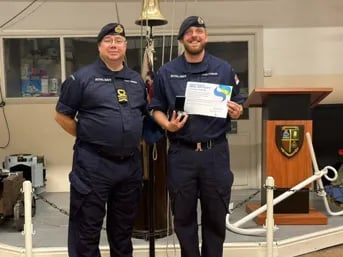
From cadet to volunteer: Matthew Thorpe's commitment to developing future generations

As HR leaders, we are constantly thinking about how we build the skills and capabilities our businesses will need in the future. We know that our businesses will continue to evolve and what we need now, isn't necessarily what we'll need in the future. How do we attract the right people? How do we develop our future leaders? How do we make sure we are building a workforce that can adapt as the world of work changes?
I don't think all the answers sit within the workplace and more employers, I believe, are waking up to that fact.
In the past few years, there has been a noticeable shift towards offering employees paid volunteering days and opportunities. Almost two thirds (62%) of businesses in the UK now offer paid volunteering time, according to research by the Royal Voluntary Service (RVS).
We know that some of the most valuable experiences people bring into the workplace come from outside their day job and in their communities, such as through volunteering. Yet such a such a huge amount of volunteering experience is being left unused.
of paid employee volunteering time goes unused every year
Potential productivity gains a year for the UK economy
Analysis by the RVS and Centre for Economics and Business Research found that more than 140 million hours of paid employee volunteering time goes unused every year and, if used, could generate potential productivity gains of £32.5 billion a year for the UK economy.
That is a significant opportunity, but I don't think the answer is to simply offer more volunteering days to all employees. We need to be more targeted.
Businesses need to think where can our support make the biggest difference, both to our people and to the communities they are contributing to?
The Cadet Force is a good example of this.
Behind the thousands of young people taking part in the Cadet Forces is a huge network of adult volunteers giving their time, energy and expertise to make those experiences possible.
Those volunteers are developing themselves at the same time, whether that be through leading, communicating, problem-solving. The human skills that have value in any workplace, and which are going to be at a premium in the years to come as we continue transitioning to embedding AI.
A Cadet Force Adult Volunteer doesn't leave those skills at the door when they arrive at work on Monday morning.
For a business like Sodexo, which has deep roots in the Defence sector, enabling the many adult volunteers employed here with additional paid leave to maintain their commitments, while enjoying a better work-life balance pays back three ways. It's good for the individual, their motivation, their wellbeing, and their engagement. It's good for the young cadets and the community they serve. And it's good for business as this reinforces our close partnership with the Armed Forces.
That's what a targeted volunteering policy can achieve.
We no longer talk about careers as being completely linear. People build careers from a series of experiences and different 'skills blocks' that they can take with them and build on over time.
Volunteering can, and should, be one of those blocks. Employers have a responsibility to identify and open-up these types of opportunities, which can deliver a genuine return to the business three times over.
We're delighted to be showing leadership in this area this week, during the UK's first-ever National Cadets Week, by providing 10 extra days paid leave for Cadet Force Adult Volunteers. It shows that Sodexo is thinking differently about how we build the workforce of the future, and we hope to see more organisations follow suit.
Explore more with Sodexo
A career at Sodexo
Further reading