Helping students to understand the carbon footprint of school meals

A trial initiative between Sodexo and Oasis Community Learning is encouraging young diners at two secondary schools to think about the power they have to make climate conscious choices at mealtimes. Read this case study to find out how students can help minimise damage to the planet by opting for low impact dishes.
Why sustainability in schools matters
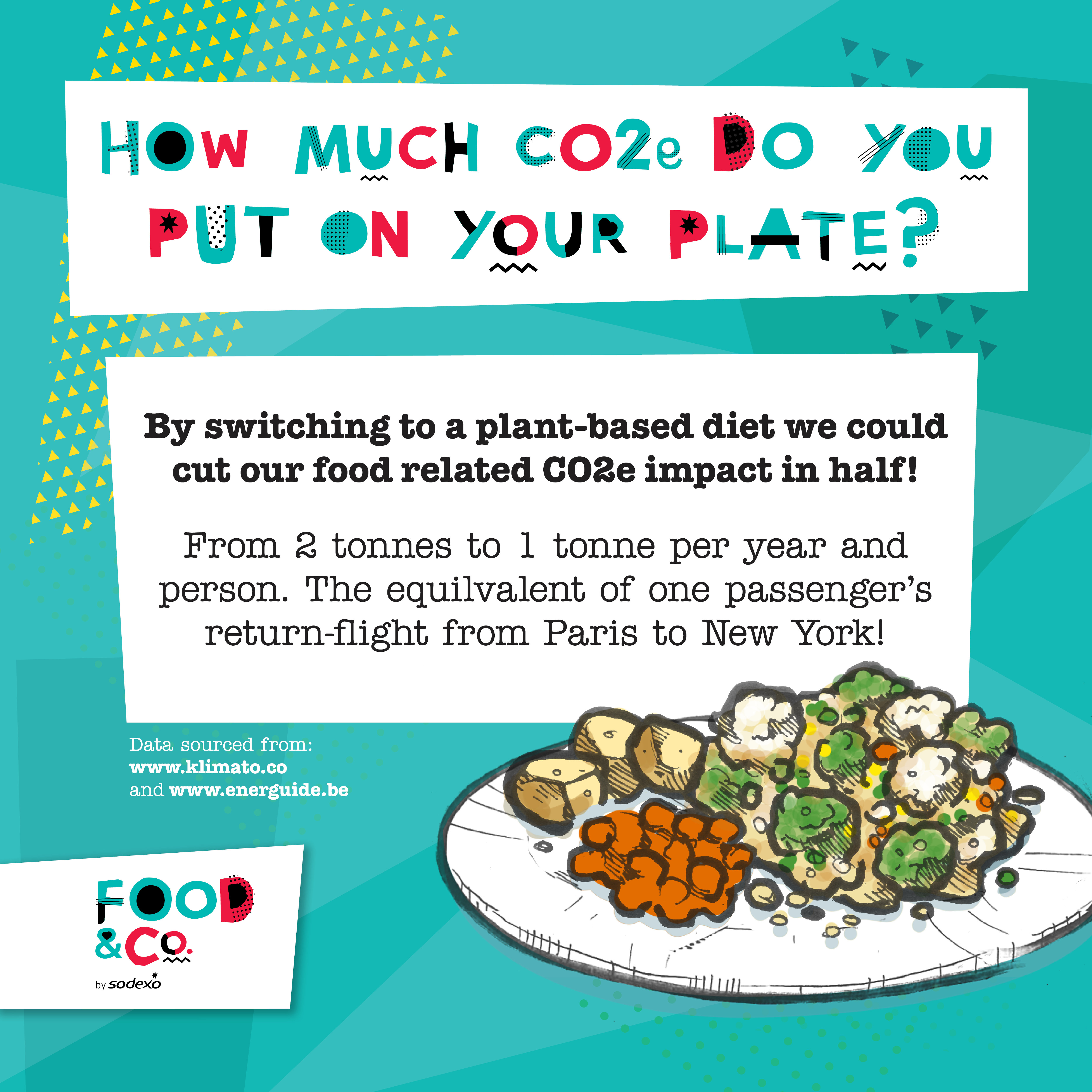
The food industry accounts for around 30% of all greenhouse gases emitted around the world.* Studies suggest this figure could be cut in half if more people were encouraged to think about how much CO2e they put on their plates, and adapt their diets to introduce more climate-smart food to mealtimes.
As a provider of more than 100,000 school meals per day around the UK, Sodexo has a responsibility, and a desire, to promote sustainable food choices and play an active role in empowering our young people to choose more CO2e friendly dishes.
*Source: WWF
Calculating the carbon footprint of our school meals
We have been working with two Oasis Academy secondary schools – Arena in Croydon and Media City in Salford – to trial a CO2e labelling application. The app calculates the quantitative carbon footprint of each of the main courses on our secondary school menu and has generated a traffic light system with ‘low-medium-high’ CO2 emissions labels so our young diners can see at a glance the impact of each dish.
“Sustainability and carbon emissions are top priorities for Oasis and its students”, says Karen Scammel, National Account Director for Sodexo Government Schools. “This is one of the ways we are looking to support their ambitions to reduce their CO2e impact and also dovetails into Sodexo’s goal of reducing carbon emissions by 34% by 2025."
“Using the CO2e labelling helps pupils to make more sustainable choices and educate themselves about the carbon footprint of food more generally. We are equipping our diners with thought-provoking food facts that they can closely relate to.”
Putting CO2e into perspective: did you know?
- One beef burger uses up one third of your weekly carbon food budget. Your weekly carbon budget is derived from WWF and their One Planet Plate initiative based on the UN Sustainability Goals for 2050 and is roughly 11 kg CO2e per week. The average beef burger emits 4 kg CO2e.
- Eating one beef burger is equivalent to eating one vegan burger AND watching TikTok for 22 hours and 48 minutes.
- By switching to a plant-based diet we can cut our CO2e food related impact in half, from 2 tonnes to 1 per year, per person.
*Source: Klimato
Why we asked pupils ‘Do you know how much CO2e you put on your plate?’
Sodexo’s marketing manager for Schools and Universities, Irmina Pala, worked with our creative team to design eye-catching promotional artwork for dining rooms, pull up banners, bunting, flyers and branded t-shirts to launch the initiative at the two trial sites.
“We also created a buzz by running a prize loyalty card competition where pupils received a stamp for every low carbon meal they chose, with the chance to win a £350 voucher for anyone collecting six stamps”, says Irmina.
Impactful results to build on for the future
The campaign has captured the imagination of the students and results from the initial months of the trial, which began in February, show an increase in uptake of CO2e friendly options at both Oasis Academies; Media City and Arena.
At Oasis Media City:
- The average kg C02e per meal went from 0.6* in December 2021 to 0.4* in February 2022.
- The number of students choosing ‘low’ (0.1-0.5 kg CO2e) climate friendly meals increased from 78% to 90% over the same period.
- In one month the site saved 622 kgs CO2e, the equivalent of flying economy to Malaga in Spain**.
At Oasis Arena:
- The average kg CO2e per meal reduced from 0.5 in December 2021, to 0.4 in April 2022.
- The number of students choosing ‘low’ (0.1-0.5 kg CO2e) climate friendly meals increased from 71% to 88% over the same period.
- In one month the site saved 241 kgs CO2e, equivalent to flying economy to Geneva Switzerland.***
“Opting to choose a more CO2e friendly lunch may seem like a small gesture for an individual but when people change their behaviours in large numbers it really adds up”, says Karen Scammel.
We’re sharing our monthly reports with the teachers and posting them up for students so they can see the trends and positive impact this is having. The trial has been a big success. We have now rolled this out across a further ten secondary schools across our Oasis Academy portfolio and are looking forward to seeing further positive results.
The results from the trial are also helping to inform ongoing menu development. Across both academies, chickpea curries and white bean chilli dishes are proving popular, whilst popular high CO2e recipes such as beef jollof, cottage pie and beef lasagne are being reviewed to replace part of the meat content with high quality plant-based protein alternatives. As a result, we are able to lower the carbon impact of that dishes while encouraging students to make sustainable food choices in their daily lives.
*Against a UK average of 1.6.
**Based on a saving of 0.2 kgs CO2e per meal sold in the period (0.2 kg CO2e x 3110 = 622 kgs CO2e). Carbon saving comparison based on carbon footprint calculator http://www.carbonfootprint.com/calculator.aspx
***Based on a saving of 0.1 kgs CO2e per meal sold in the period (0.1 kgs co2e x 2406 meals = 241 kgs CO2e). Carbon saving comparison based on carbon footprint calculator http://www.carbonfootprint.com/calculator.aspx
Sodexo schools
Learn more about our services for schools