
FM innovation starts with better questions

Natalie Green (1)
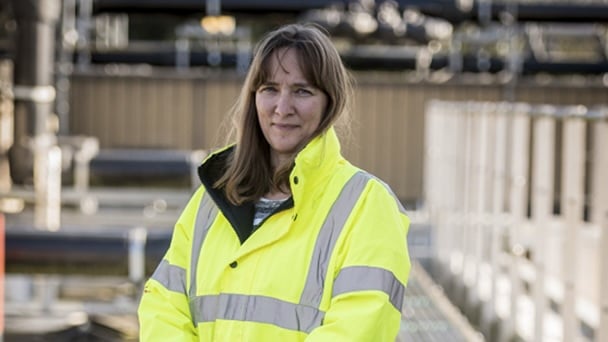
Natalie GreenDigital FM Operations Director

With AI set to reshape every industry, the challenge for facilities management is to turn that potential into better service and tighter cost control. But a blind rush for the newest technologies could mask what really drives efficiency: solving everyday problems. Our FM innovation director Natalie Green explains how the best solutions often mix the simple with the cutting edge.

sodexo-hq-osr_503x503

Businesses are facing a perfect storm of rising prices and productivity challenges, creating a tension between tight cost control and seamless employee services. My team exists to relieve that tension by solving the little frictions that drain efficiency from the working day. The aim is to improve service without adding complexity to the working day. 


Amid endless possibilities, it’s still the problem that matters Technology is transforming how Sodexo does FM. 


From intelligent building management to smart food lockers, it helps us deliver better workplace experiences and tighter cost control. With agentic AI expected to revolutionise how everyone works, should all our innovation investment be directed this way? 


Not yet, no, because innovation is about solving problems. And if your mindset shifts from the problem you’re trying to solve what technology might be capable of, you lose that connection to what the client really needs and risk overstating the real-world benefits. The test should be the friction an innovation removes and the improvement it proves.

26%

reduction in unnecessary administration for clients.

Simplifying Daily Operations with Proven Technology

Our technicians told us that their day was often interrupted by having to log in to key systems repeatedly to complete risk assessments and work orders. So, we introduced biometric login. By creating a simple and secure way to complete key tasks and get on with their day, we reduced unnecessary administration by 26%. For clients, the value is in giving technicians more time to focus on resolving the faults that disrupt their business.

Connecting the service response 

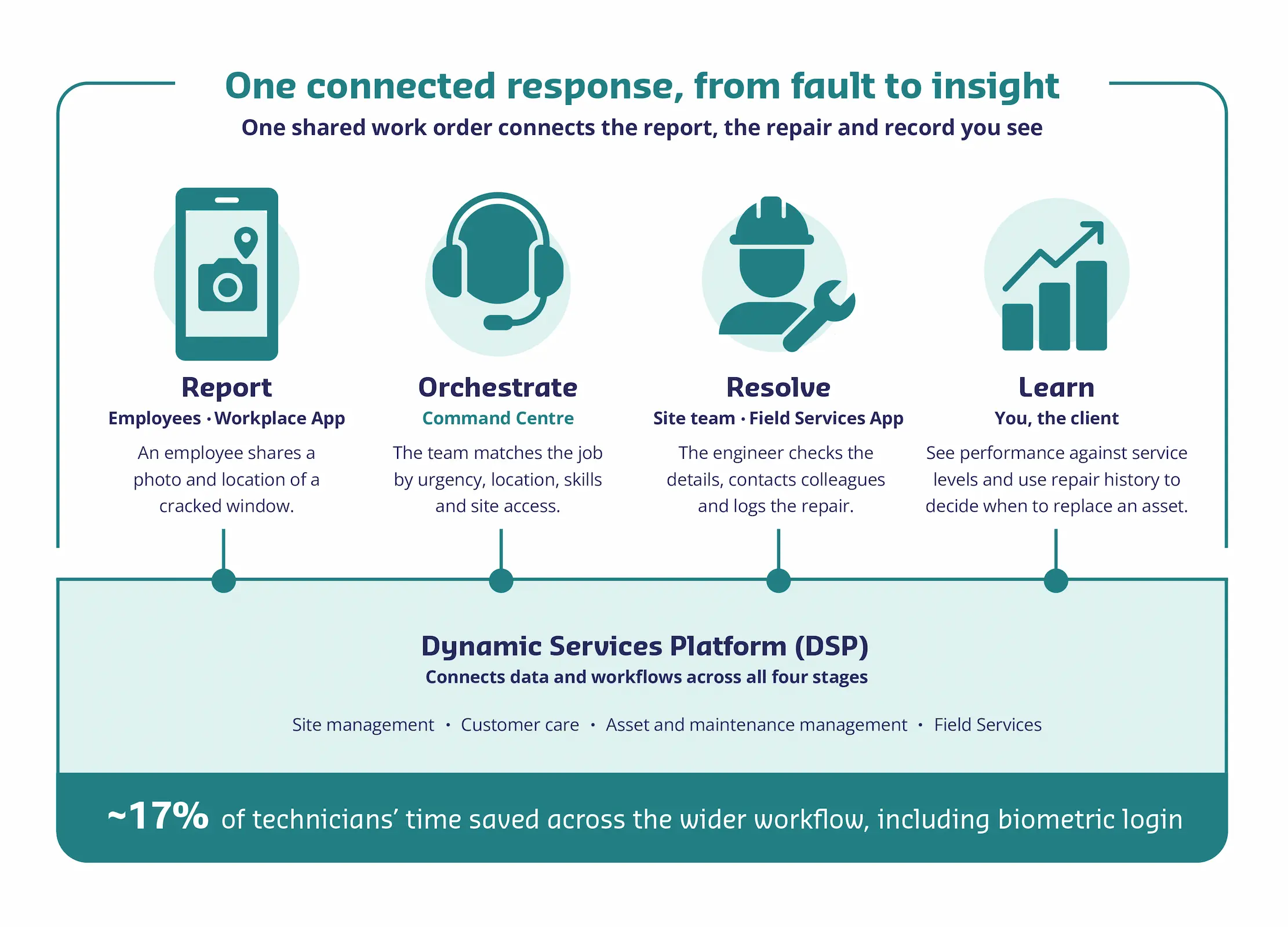
Removing friction from individual tasks is only part of the story. To keep the whole service response efficient, our command centers take client requests through our data ‘spine’ to enable a rapid response on site. 

That journey starts with making a problem easy to report. Through an AI chat bot within our Dynamic Service Platform (DSP), an employee can alert us to a cracked window, locate it and share a photo. The AI bots gather the detail needed for a clear work order, with our teams stepping in when human support is needed.

Dynamic scheduling then assigns the right engineer and, for critical faults, diverts the expertise needed to that site while resetting the schedule and reallocating other jobs where needed. It considers the engineer’s location, skills and access to the site, helping us respond to urgent problems while keeping other commitments on track.

Two men in safety vests standing in front of a large industrial building

Engineers can also communicate with managers and colleagues directly within the work order, rather than switching between systems or making separate calls. Across this wider technician workflow, including biometric login, we’ve reported savings of around 17% of technicians’ time. It’s about using data in the right way to give our people and our clients a seamless day.


AI can support the technical response too. With our health and care clients, we will be using it to report on asset behaviours and help identify why equipment may be failing. That helps engineers get to the problem more directly, rather than spending time investigating every possible cause. The technology supports their expertise rather than replacing it. 

Turning operational data into useful decisions

The value of a connected response extends beyond resolving the immediate problem. The system records the journey from the initial report through to the work carried out, creating an audit trail clients can use to understand what happened and how we responded against our contractual commitments.

Our data hub also brings information together to make it meaningful for different roles. A finance director can understand the cost associated with a failed asset, while a site manager can see the operational impact. They are looking at the same data, but through the lens of the decisions they need to make. For example, recurring faults, repair costs and disruption could help them assess whether replacing an asset would offer better value than continuing to repair it.

One connected response diagram

Our technology roadmap extends beyond 2030, but the principle is already guiding our approach. From reducing compliance risk to driving efficiencies and improving employee engagement, we want to solve the challenges our clients face by pinpointing which actions will drive value. AI supports that process, but only as an enabler of the outcome, not as an end in itself.

For clients assessing an innovation, the questions are practical. What friction will it remove, what will improve, and how will that improvement be demonstrated?

Further reading

Person wrapped in a knitted blanket looking out of a window in a quiet indoor setting.

From Support Service to Strategic Enabler: The Evolving Role of Estates and Facilities in Mental Health 

Discover how healthcare estates and facilities management can improve mental health services through safer environments, patient-centred facilities, food provision and clinical partnerships.
friendly-engineer-driving-to-job

A tale of two models: single supplier vs integrator

View the differences between single supplier and integrator models in facilities management, including their impact on workplace experience, agility and innovation.
Joanna Harris onsite

Why engineering excellence requires a people-first mindset

Learn how engineering excellence, smart buildings and facilities management can enhance occupant wellbeing, workplace experience and sustainability.