Young women at HMP Bronzefield gain skills and motivation through The Duke of Edinburgh’s Award

Source: The Duke of Edinburgh 's Award
Participant in the DofE at HMP Bronzefield
Young women at Europe’s largest women’s prison have been given the opportunity to change the trajectory of their life by learning vital new skills through a life-changing Duke of Edinburgh’s Award (DofE).
The DofE charity, in partnership with at HMP Bronzefield, a women’s prison and Young Offenders Institution (YOI) in Ashford, Surrey, is providing focus, motivation and responsibility through the DofE. Once complete, the programme gives young women – who are some of the most marginalised in society – a widely respected Award which can help them positively reintegrate and fulfil their potential upon release.
In the last year (2024-25), six young people achieved a DofE Award at HMP Bronzefield, contributing 143 hours of volunteering, with a financial value of £915. Currently, 12 young people are working towards their Bronze Award, and three are working towards their Silver.
Activities are carefully shaped to create a sense of connection and purpose: for their Volunteering section, the young women take part in Parkrun, teach their peers to read and play chess, and they offer meditation and Zumba classes; for their Skills section, they learn embroidery, tapestry and sewing; and for their Physical, they attend regular gym sessions to improve their health.
Many of the women train for Hyrox, a challenging fitness discipline that blends endurance and functional strength, offering something they can continue to train for, and compete in, upon release.
Tom Walsh, Prison Custody Officer, and Duke of Edinburgh’s Award Leader at HMP Bronzefield, credits the DofE for developing the women’s soft skills, employability prospects and empowering them to support other prisoners.
A lot of people think that their chances of getting a job have diminished now they've come to prison, and we can show them that it isn't the case.
It could be the start of the journey for them. They might not have accomplished anything prior to this.
Coming into prison, as much as they didn't realise at the time, could have been a bit of a lifesaver; they've started to achieve things and to empower themselves. Their mannerisms and punctuality change.
They can look back and remember what they've achieved and when they're going for that next job interview, they can showcase themselves upon release as they’ve got something to look back on and something to recognise and to remember.
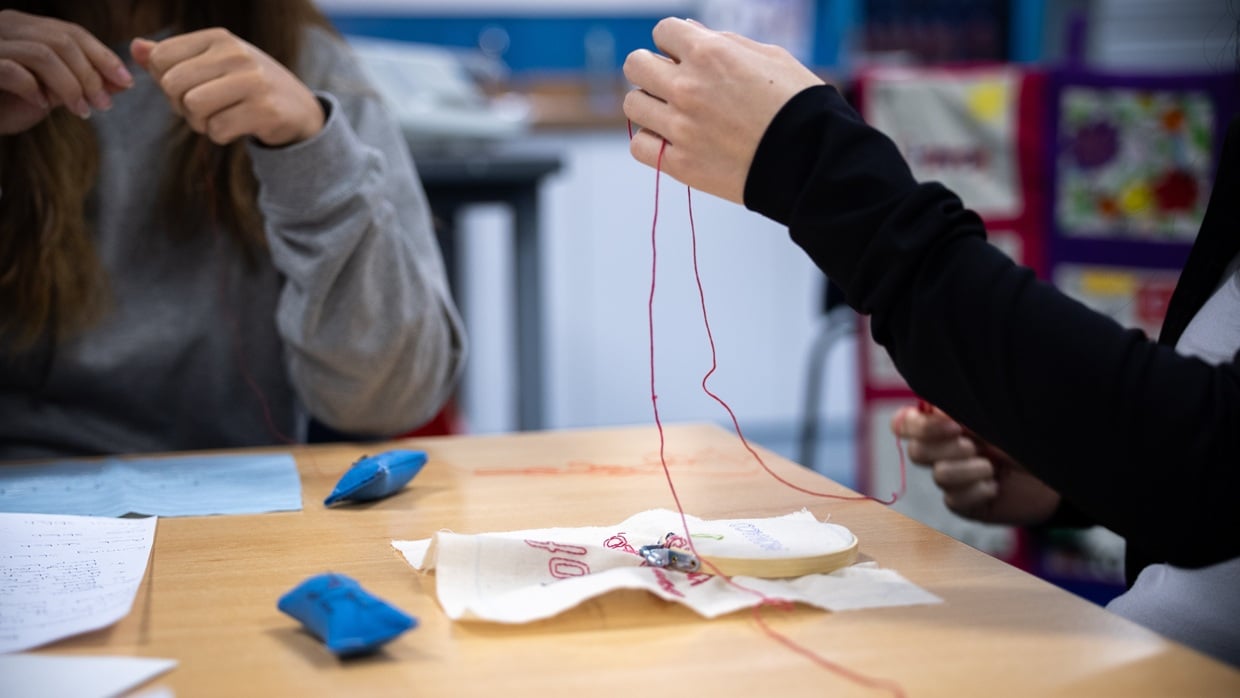
Source:, The Duke of Edinburgh's Award (DofE)
DofE participants at HMP Bronzefield learning embroidery, tapestry and sewing for their DofE Skill section
Maisie*, 19, who recently achieved her Bronze Award at HMP Bronzefield, credits the DofE for helping regulate her emotions and revealing hidden strengths.
I became a young carer about age 13. I was in charge of looking after my mum and my siblings. I never necessarily had time to be a child. There are certain choices that I made that did lead me to come to jail and that's because at the time, I felt like I didn't necessarily have a choice. It was like I was thrown into this big world of adult responsibilities, and I didn’t necessarily know how to handle it.
When I was arrested, I felt like this was the end of the world but when I had done The Duke of Edinburgh’s Award, it was like, even though times are a bit rough, look at what you've done. So when you do get out, your life's not over. You have something to prove that you used your time well. You can keep going. I feel like I have my whole life ahead of me.
There would be times when I was like, okay, I'm ready for the day, but there were times I was kind of flat on my face. Doing The Duke of Edinburgh’s Award has helped me regulate my emotions. It gave me a sense of routine and belonging. I'd wake up every day and be like, okay, you feel like this, but you have something to do. You have something that you can get out of bed and be like, okay, I can do this. And there was like a sense of achievement.
Open to 14 to 24-year-olds, young people in prison complete challenging Skills, Physical and Volunteering sections like other participants. However, for their Expedition, they follow DofE guidelines on completing expeditions, but tailor the challenge to the space available. The outcomes are the same as those for all DofE participants – with young people carefully planning their routes, training, carrying out team challenges, and completing their journeys using gym equipment.
Sapphire, 23, who is currently working towards her Bronze Award, planned a virtual expedition to Monaco with her DofE teammates, and said doing the DofE has pushed her to be a better person and has improved her fitness and wellbeing.
The Friday before the expedition, we sat there together to calculate the distance and how we want to go about it, by land and by sea.
We then had Monday, Tuesday, Wednesday to do it. I started with rowing; I did like eight kilometres that day, then went cycling and then we had to do five kilometres on the treadmill with our camping bag.
Then we used the cycling and spin machine and skied certain kilometres. On Wednesday we re-enacted camping in the field. We set up our tents, basically just like we're in the woods.
Older prisoners, and former participants like Maisie, play a mentoring role, offering support, encouragement and leadership to the younger cohort. This peer-to-peer approach helps build a strong sense of community within the prison, and reinforces the prison’s focus on rehabilitation, personal responsibility and positive relationships.
Maisie, who discovered she was great at motivating other women to achieve their fitness goals whilst doing her DofE Physical section.
Volunteering pushed me to be an Activities Peer. I’m able to get more people involved. It brings a sense of happiness because it's like everyone's going through their own battles in here. Everyone has their low days and I like making people feel good about themselves. It's one of the greatest feelings to be able to say I've done it, I've finished it, and I have something to show for it.
When Maisie is released from prison, she wants to “repay the love” that has been shown to her by sharing her experience to help young people navigate their life. She also wants to continue encouraging other prisoners to do their DofE.
Young people in the prison system are among the most marginalised in society and often have limited access to qualifications, opportunities and aspirations. The DofE provides focus, motivation, responsibility and an opportunity to give back. Once complete, it gives young people a widely respected Award which can help them positively reintegrate and fulfil their potential.
Nearly 400 young people started a DofE Award in custody in England and Wales in the last year. We’re making it our mission to deliver DofE in every eligible English and Welsh young offender institution and prison by the end of 2026, as well as working with those on probation, or at risk of entering the system – so even more young people have the chance to change the trajectory of their life.
There are over 3,400 women in prison across England and Wales, accounting for 4% of the total prison population; of those 3,400 women, 12% are aged between 18 and 25. The DofE operates in 46 prisons and young offender institutions across the UK. In the last year alone (2024-25), 390 young people started their DofE – 5.8% were women**, earning qualifications in Active IQ and literacy, to boost employability on release.
The Duke of Edinburgh’s Award is committed to breaking down barriers to give as many young people as possible the chance to do their DofE, with a particular focus on supporting those who currently face barriers to participation, including young people experiencing poverty, with additional needs and young people from ethnic minority backgrounds.
Sodexo is committed to supporting marginalised groups within local communities. Its recruitment strategies include helping people with convictions through its Starting Fresh programme which leverages its experience in the justice sector to advocate for and provide employment opportunities for people with criminal convictions.
- *Maisie’s name has been changed for anonymity purposes.
- **Data relates to the period April 2024 to March 2025. 5.8% were female, but this only accounts for those that declared their gender.
- An Activities Peer supports staff to plan, deliver and supervise activities within the prison, with the aim of promoting positive behaviour and wellbeing plus reducing self-harm and violence.
Delivery of The Duke of Edinburgh’s Award in the youth justice sector is possible thanks to support from the Ministry of Justice, HMPPS and the DofE’s funders: Aldo Trust, The Christopher Laing Foundation, Gordon and Hilary Phillips, and the Julia Rausing Trust.
Find out more about The Duke of Edinburgh’s Award and its work in the youth justice sector
Find out more about Sodexo's justice business